Feeds:
Posts
Comments

Archive for April, 2017

Japan – Nagoya

Day 12 – 7 th April 2017.
Nagoya/ Tokyo
After breakfast we all gather in the hotel reception prior to travelling by bus to the very impressive Toyota Museum in Nagoya. However, before setting off we say a very fond farewell to our young friend from Virginia, Luke, who is leaving the tour a couple of days early to spend some time with a friend in the USA who has managed to get much sought-after tickets to a Japanese Major League Baseball game. Apart from reducing the average age of our group of Grey Nomads by a considerable number of years he has at all times been an amiable, knowledgeable, entertaining and most of all an adventurous young guy, always ready to immerse himself in all that Japan has to offer. We will miss having him around.
In what is basically a self- guided tour we first learn that the company initially known as Toyoda was founded towards the end of the 19th century by Sakichi Toyoda and become a significant player in the textile industry, especially after Sakichi invented an automatic loom.
However, during a visit to the USA Sakichi’s eldest son, Kiichiro, saw for himself the burgeoning automotive industry which was clearly going to make such a huge contribution to the USA economy.
Kiichiro returned to Japan and set up an automotive division of the company that has gone on to become the world’s largest car manufacturer.
This superb museum was founded in 1994 and it is interesting to note the contrast between this exhibition and the automotive museum in Turin, Italy, which Gail and I had visited 3 years earlier.


The admittedly magnificent Turin museum focuses far more on the glitz and glamour of cars and includes a section on the world of Grand Prix racing whilst the Nagoya Toyota museum gives far more emphasis to the technical aspects of car manufacture with not a Grand Prix vehicle in sight. Probably a reflection on the two nationalities!
An interesting footnote on the change of the company name from Toyoda to Toyota and 2 photographs have been attached which explains this move.

In another effort to balance the ‘ Cherry Blossom’ ledger Chiaki suggests that we take a quick trip on the train out to Nagoya Castle where, we are promised , cherry blossom will abound and she proves as good her word. As time is short most of the group do not go inside the castle grounds but the glorious display of blossom in the areas outside the walls is all that we could have wished for.


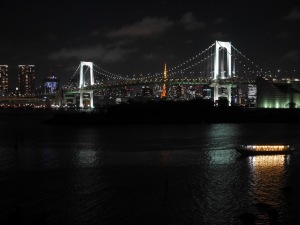
Finally, it’s time to travel back to Tokyo by Bullet Train and after a few subway changes to get across the city we check into the splendid Grand Nikko Tokyo Diaba. Diaba is an area which is primarily on reclaimed land and we travel across the remarkable Rainbow Bridge on a driverless train and on a track which does a form of ‘loop the loop’ to avoid too steep an incline onto the bridge. We notice that some very keen passengers try to get on the train first so that they can occupy the seats at the front, probably living out some long-held childhood dream.


As an introduction to the Diaba waterfront Chiaki takes us on a quick sunset tour to view the city skyline across the water and the faux Statue of Liberty, although we are all rather bemused as to why Tokyo should be celebrating the 4th of July 1776, US Independence Day and the 14th July 1789, Bastille Day.
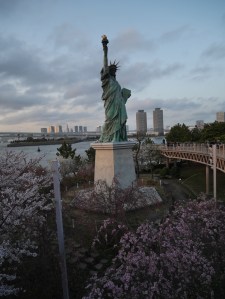
P1090341


Maybe it has something to do with the hold Starbucks has on the coffee scene here and the presence of the excellent Vie de France boulangerie chain which we have come across during our travels.


P1090360

Rainbow Bridge & Tokyo Tower

Fuji Television & Tokyo skyline from Daiba

Off in search of a view of Mt Fuji tomorrow.

Cheers

The Obese Ferret.
Read Full Post »

Japan – Ondawa

Day 11 – 6th April 2017

Ondawa
Gail and I are up and about far earlier than usual as we are keen to take another hot bath in the hot spring before breakfast. Once again I am the only one in the hot bath so clearly the other male guests at the hotel are intimidated by my Obese Ferret torso!
An early start as breakfast is at 7.30 and what a breakfast it is! Whilst nothing could compete with the dinner laid on for us the previous evening the breakfast offered is an amazing selection of both Japanese and Western food.

P1080999

We now have some free time to stroll around the village and take more photographs of this beautiful location. We also find the best coffee of the trip so far at the St Anton Coffee Bar.
Marlene, another of our travelling companions, provides us with some humour when she lets us know that the idea of the local inhabitants queuing up naked for the open air baths (available only to local villagers) is for her a bridge too far. She is,therefore, greatly relieved when it is pointed out to her that these hot springs are only for cooking!

We eventually say our goodbyes to this wonderful resort hotel and the superb staff and headed back to Liyama where we boarded another Bullet Train for a short 11 minute journey. We then journey further south through the magnificent mountain scenery of the Kiso Valley, taking a detour by coach to the small town of Tsumago which was  the 42nd of the 69 staging post towns along the Nakasendo road linking Edo ( now Tokyo ) with Kyoto. Sections of this old road have been restored and the people of Tsumago, in their efforts to preserve their historic town made three basic rules, namely ” do not sell, lend or destroy ” any houses. Evidence of their success with their campaign is there for all to see as one strolls through the Main Street.
There are also some attractive small stores and we manage to purchase a lovely scarf as a gift for Chiaki.

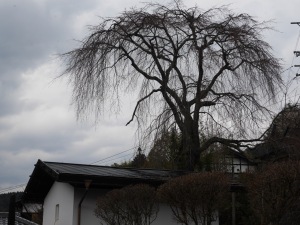
Chiaki had earlier told us of a 400 year old cherry tree which promised to be laden with blossom. What we find when we reach the site will come no surprise to you but it is a beautifully shaped tree!

P1090095
Now it’s on to Nagoya where we book into the Meitetsu New Grand Hotel.
In an effort to compensate for the lack of blossom Chiaki takes us over to the Tsuruma Park near the railway station where we are finally able to see a spectacular display of cherry blossom, all under floodlights. Although it is by now teeming with rain this in no way discourages the hordes of locals, some of whom have laid out tarpaulins for an evening picnic, from having a whale of a time as they celebrate the start of spring. The alcohol intake increases as the evening wears on and predictably the younger generation, in particular, become increasingly more boisterous.


As we start heading back towards the station Gail encourages me to use my GoPro to get some close up of the blossom. She forgets that this will slow me down a little and moves on ahead into the crowd. By the time I have done my GoProing she and the others have disappeared. I, therefore, fall back on the rules set by Chiaki earlier, return to the station and wait there. After waiting a fair time I back-track to the park and eventually find the rest of the gang.
Inevitably, I become the prodigal son who lost his way while obeying the rules but Chiaki supports my version of events.!

Cheers
The Obese Ferret.

Read Full Post »

Japan – Nozawa

Day – 10 5th April 2017
Kanazawa/Jigokudani Snow Park/Nozawa Onsen Village
The weather is being kind to us again as we set off on the Bullet Train from Kanazawa to the small town of Liyama where we were met by coach and taken to the Jigokudani Monkey Park. We then uembarked on a fairly steep trek up a track made very slushy by the thawing snow. Chiaki has forewarned us that there no guarantee that we will see the snow monkeys but when we arrive at our destination we are thrilled to see so many monkeys on the partially snow-covered slopes and along the paths themselves. Even more of a bonus we can observe so many of the animals swimming in the warm water pools and the young frolicking about like young children. The photos accompanying this blog will do more justice to this scene than I can.


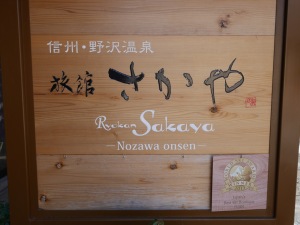
We stay up at this site as long as our timetable allows but all too soon it’s time to get back to the coach to be taken to the railway station and our onward journey to Nozama Onsen a very attractive village/ ski resort situated in a picturesque corner of the eastern Japan Alps. Here we are booked in for one night at the Ryokan Sakaya which in 2013 was World Ski Award’s Best Ski Boutique Hotel winner.
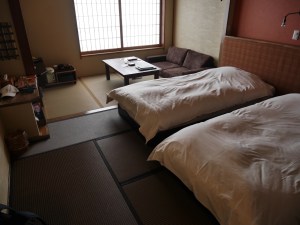
As we check into the hotel it is immediately clear why they received such an accolade. The rooms are beautifully appointed, the staff are the epitome of professionalism and this is a very traditional Japanese ryokan.

P1080939   P1090010

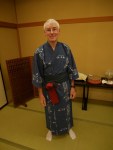
We are required to remove our shoes and put on slippers before setting foot in the hotel proper and similarly we take off our slippers and put on hotel-supplied socks when we enter the bedrooms. We are provided with traditional Yukata ( a type of kimono ) and a Tanzen ( jacket that goes on over the Yukata )which we are expected to wear for our evening meal and we are urged to take a bath in a traditional pool in the hotel. Chiaki stresses that this means putting aside any modesty and going the ‘ full monty’.     P1080971

Before we go to dinner we are taken on a quick tour of a part of the village, stopping along the way to take a quick look into a public bath where four naked guys in the hot water seem none too pleased by these intruders.

We also pass an area reserved for local villagers only who are able to use the hot waters to do some cooking and see a couple of young boys who are about to slow boil some eggs in the natural hot water. Finally, before we head back for dinner we are able to view the whole village from a great vantage point above the valley.


Back at the hotel both Gail and I take the plunge so to speak although thankfully no-one else was in the baths at the time.


   The Ladies Baths including outdoor pool

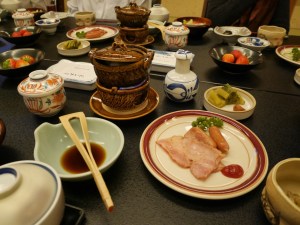
Dinner is an unforgettable experience when all of our group arrive resplendent in traditional garb and we are then treated to an incredible selection of some very fine Japanese food prepared by a Michelin 2 star chef.

To top it all off Chiaki, who used to be a singer in a group, convinces us all to become involved in a Japanese game played while accompanied by a song Kompira Fune Fune ( on this occasion sung by Chiaki ) with Liz from Sydney coming out the winner. This game is usually played on the occasion of a Geisha dinner or party.
Off to bed after yet another very rewarding day on what is becoming a magnificent tour, due in no small way to the fantastic performance of our guide ‘ par excellence’ Chiaki’.
Cheers

The Obese Ferret

Read Full Post »

Day 9 – 4th April 2017
Takayama/Shirakawa-go
Superb breakfast taken on the 16th floor of the hotel on a clear sunny day and then it’s off by coach to the delightful town of Takayama situated southeast of Kanazawa.
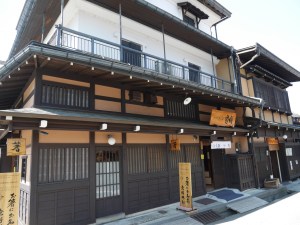
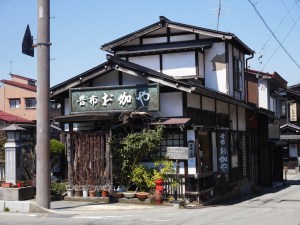
We are allowed plenty of free time to stroll through the town which, by virtue of its isolation, has been able to preserve so many of its Edo period streets, tiny shops and museums. There is also no shortage of eating places, be they restaurants, cafes or take-away stalls.

P1080632  P1080637
All of these quaint streets and also the market are contained in a small area to the east of the Miyagawa River.
We manage to buy a couple of Hida Beef Manju ( Bun) from a stall and although the amount of beef in the bun falls somewhat short of that shown on the advert outside the shop it still makes for a very tasty lunch snack. Moreover, we come across an elegant coffee lounge with excellent coffee. The fact that Keith, our resident barista and self-declared coffee snob, is already sitting in there is something of an endorsement.


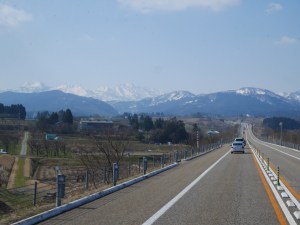
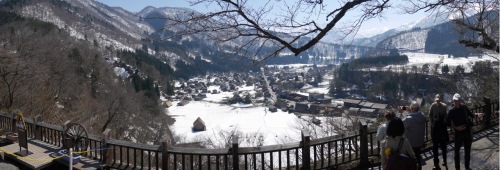
We next travel north-west through a very scenic area of snow- covered hills and mountains to the picturesque small village of Shirakawago Ogimachi, nestled among the mountains on the Sho River.

P1080601
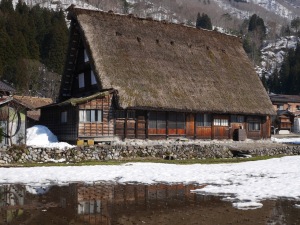
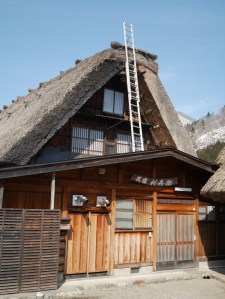
This village and area are best known for the gassho-zukuri thatched style of house and these houses are the reason why Ogimachi is now on the UNESCO World Heritage List.

P1080670
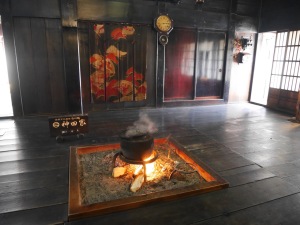
We are able to visit one of the houses for a nominal price of 300 yen and we are amazed at the number of floors the house comprises.

P1080768P1080691P1080689P1080735

P1080747

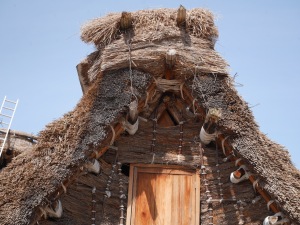
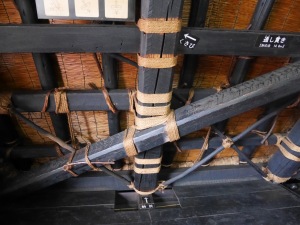
No nails used in this construction

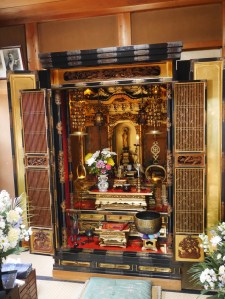
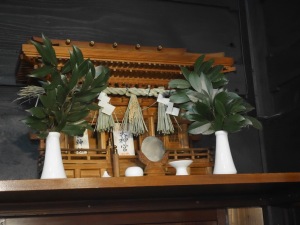
Once again we see the familiar sight of both Shinto and Buddhist altars in close proximity and Chiaki points out that the Shinto altar is always higher than the Buddhist. On the ground floor there there is also a shrine dedicated to deceased members of the family.

P1080738

Buddhist Altar

P1080754

Shinto Altar

Chiaki explains that the house was originally involved in sericulture ( manufacture of silk) and,somewhat incongruously, gunpowder.

There is also still some evidence of the recent heavy snowfall throughout the area and village but this is expected to disappear within a short period.

On a rather bizarre note the entertainment for the day is provided by a rather large man ( seemingly of east European origin) and his wife. He is ranting and raving at his wife in a very loud voice and seems to be on the verge of flattening her at some point. The last time we see them she is heading off in one direction and he in another, maybe off to start another Balkan War!
Dinner back in Kanazawa is in an Italian restaurant which offers fine fare although we have all become well adjusted to Japanese food.
A most enjoyable day in some glorious weather and mountain scenery.

Cheers
The Obese Ferret.

Read Full Post »

Japan – Kanazawa

Day 8 – 3rd April 2017
Okayama to Kanazawa.
Time to check out of the excellent Hotel Granvia which has been our base in Okayama for the last 3 nights. We could not have asked for better accommodation.
A 45 minute train journey brings us to Shin- Osaka and then it’s on to the Limited Express Thunderbird for the 2 hours and 40 minutes it will take to arrive at our destination for the day, Kanazawa.
Kanazawa is a city of 450,000 and having not suffered any devastation during the Second World War it has been able to preserve its myriad historic and cultural sites. When you also add the beautiful samurai and geisha districts, impressive museums and temples it is little wonder that the city has become the main draw card of the Hokuriku region.
We’re first taken to the Kutani Kosen Ceramic Kiln which was opened in 1870 and a young member of the family takes us on a very informative tour of the business. He also provides us with a demonstration which perfectly showcases his expertise and artistry.


We all spend some time in the adjoining shop after the tour and the young man is rewarded for his efforts as a number of our group purchase items from the quality range of ceramics. We are also happy to linger here a while as during this visit the area is hit with a heavy thunderstorm with a dramatic drop in temperature and hail.
I think the cherry blossom buds have taken fright again!
We next visit the Sakuda Gold and Silver Leaf shop and Kanazawa’s old Geisha district Higashichaya.

(Even the ‘Ladies’ above has a touch of gold leaf)

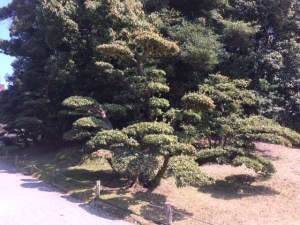
Last but certainly not least we are able take our time strolling through the Kenrokuen Gardens, ranked as one of the top three gardens in Japan. Along with so many other visitors we are disappointed by the lack of spring blossom
but nothing can detract from these truly magnificent grounds. We are at last seeing a few trees in bloom and a number of our group have commented that this very late spring may be something of a blessing as we are able to take our stroll without the usual hordes to spoil the peace and tranquility.

By the time we get back to the bus everyone else is already seated in the warmth and getting some respite from what is now a seriously cold afternoon.
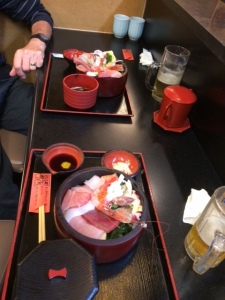
Dinner, at least for 5 of our group, is at a local sushi bar. Now I have never been a great fan of sushi but I have to say that the quality of the food is superb although the old chef is a real curmudgeon who only cracks a smile as we leave and I try to thank him in my very rudimentary Japanese.

IMG_5278 sushi

 We are now staying for two nights at the Holiday Inn Kanazawa Sky with its novel reception on the 16th floor!

Cheers
The Obese Ferret

Read Full Post »

Japan – Takamatsu

Day 7 – 2nd April 2017
Takamatsu
An ideal day to take the JR train from Okayama across the inland sea from Honshu to the island of Shikoku.
The trip across the water is an adventure in itself and the Seto Ohashi Bridge, the world’s longest two- tiered bridge system at 13.1 kms, is a miracle of modern engineering.
However, we are reminded of our lowly status in life when the announcement comes over the on- board public address system that there are two classes of reserved seats. Upstairs in the domed roof section are the ‘superior’ classes who get a much better view of the water below and the surrounding scenery and then downstairs in the basement are the ordinary class( that’s our group)! We arrive safely at Takamatsu with our self-esteem suitably damaged and take a small local train to the beautiful Ritsurin Gardens.
A local guide is on hand to take us through the gardens although her English does leave something to be desired.


Once again we are left to imagine how stunning these gardens might be with the cherry blossom in full bloom. Chiaki tells us that in all the years she has been visiting these gardens she can never remember such a late start to the Spring Cherry Blossom season.
Whilst we do manage to locate a few corners where the blossom is evident it still falls short of expectations.

P1080359  IMG_5259
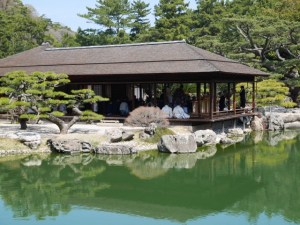
Having said that the gardens are set against a magnificent backdrop of surrounding hills and the many ornamental ponds make it an enchanting place to visit, especially when we manage to view a traditional Japanese wedding ceremony, albeit at a distance. Moreover, the later-than-usual start to the cherry blossom season in no way deters the many visitors from enjoying a picnic with family/friends in various locations throughout the park.

P1080390


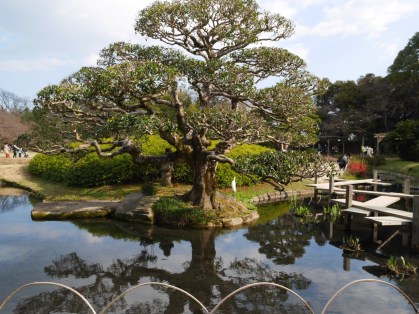
We return to Okayama by the same route and as we have some time to spare we use the rest of the afternoon to visit the splendid Korakuen Gardens and the striking black Okayama Castle, otherwise known as Crow Castle for obvious reasons.

P1080439

Chiaki travels with us in the taxi to the gardens and we have just entered when she see two lovely young ladies dressed in the most exquisite kimonos which we are told they are wearing as part of a Kimono festival.

P1080477
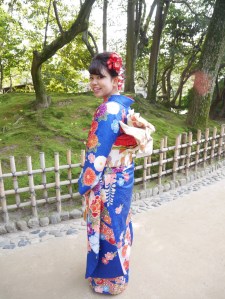
A short time afterwards we meet another beautiful girl in a very decorative kimono together her two sisters and a very proud father. This celebration is apparently to mark her ‘ coming of age at the grand old age of 20.
Chiaki has found a typical Japanese ‘pub’ for our evening meal and 9 of us take the short walk from the hotel to the venue. What follows is a fine meal in a great atmosphere with some of the guys( including yours truly) knocking back some very large glasses of beer and the ladies not far behind with their sake. The food is similar to that served when a small group of us dined out at another small restaurant a couple of days earlier but without anyone smoking in the room.
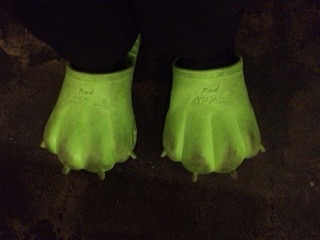
We are required to take off our shoes on entering the pub and when Gail later needs to go to the toilet she has a fit of the giggles when she sees the lime green sandals that she puts on for the purpose. I suspect that the sake has a part to play in this performance.IMG_5265

Cheers
The Obese Ferret

Read Full Post »

Day 6 – 1st April 2017
Okayama/ Hiroshima/Miyajima Island
We have been anticipating this day for some time now but given the devastation wrought on Hiroshima on the 8th of August 2017 we expect the visit to this site to be both exciting and very confronting.
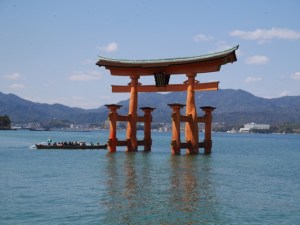
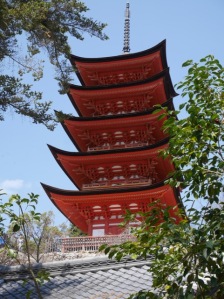
We are blessed with some fine weather as we take the short rail journey to Hiroshima and on arrival take a short walk to the ferry terminal from where we will leave to cross to Miyajima Island, famous for Itsukushima Shrine and the floating torii gate. This gate is officially one of Japan’s ” Top 3 Views” and another UNESCO World Heritage Site. The Miyajima Sacred Goddess Floating Shrine is believed to protect the inland sea over which we have come.

P1080093


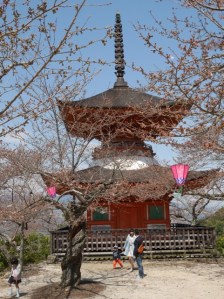
After walking along the waterfront to gain the best photographic vantage points for the floating gate we make a short climb up to a pagoda which is set amongst some beautiful CHERRY BLOSSOMS. Hallelujah!

P1080165   P1080168

P1080158                        P1080166
On the start of our walk we had spotted a specialty shop offering waffles and hot chocolate and we returned there to sample their fare.

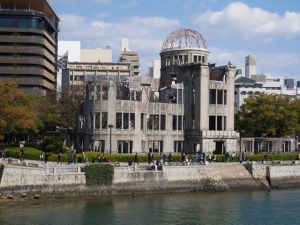
On arrival back at the ferry terminal on the mainland we take a tram to A-Bomb Dome, which marks the spot where at 8.15 am on 8th August 1945 the first atomic bomb was detonated approximately 600 metres above the city centre.
The heat rays and blast burned and crushed nearly all buildings within 2 kms of this hypocentre, taking thousands of lives and leaving many more with appalling injuries.
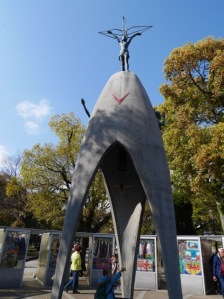
After crossing over the Hiroshima River we stop to take some photos of what remains of the Dome and then proceed into the Peace Memorial Park, stopping along the way to ring the huge Peace Bell and to view the Children’s Peace Monument.
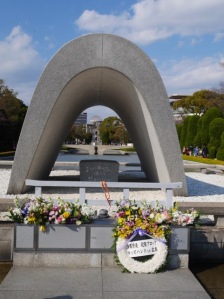
Before entering the Hiroshima Peace Memorial Museum we also stop at the Cenotaph for the A- Bomb Victims. From this location we are able to gain a memorable view through an arch all the way down to the Dome.

P1080174  P1080201

It’s now time to conclude our visit to this city with over an hour at the Museum.
Regardless of what we may have read or seen about that fateful August morning in 1945 the images and objects showing very graphically the aftermath of the bombing will no doubt remain with us for long into the future.
Not surprisingly the Museum focuses on the impact of the bombing on Japan and its people with only a brief reference to the Japanese aggression that triggered the war and its repercussions. Notwithstanding the re-writing of history that has taken place the pain and suffering is there for all to see and no person embodies this more than a girl by the name of Sadako Sasaki.

P1080191  IMG_5234
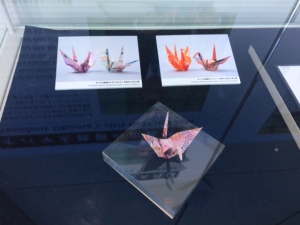
Sadako was exposed to the A-Bomb when she was 2 years old and initially seemed to have emerged unscathed to become a very good young athlete. Sadly after 10 years she started to show signs of leukaemia. However, during her fight against this illness she started doing origami with the aim of folding 1000 paper cranes in the hope of finding a cure. Despite her efforts her life ended after a painful struggle. Sadako’s plight later become known internationally and even today she remains a symbol of hope and determination.
A truly memorable and thought-provoking day ends when we return to the station and the short trip back to Okinawa.
As we don’t have a group dinner organised for the evening we all troop off to a large dept store near to the hotel and eventually we find ourselves, together with Keith, in the ‘fast food’ department on the 4th floor. Never has an area been more inappropriately named as it takes 40 minutes for two very basic pasta-type dishes to arrive. To be fair the food is very good but I was by now too weakened by the lack of sustenance to appreciate the these culinary gems!

Cheers

The Obese Ferret.

Read Full Post »

Japan – Himeji

Day 5 – 31st March 2017
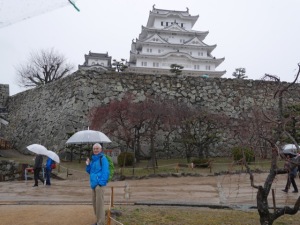
Wake up to a wet, very cold day for our trip to Himeji Castle.
After checking out of our hotel we catch the underground to Kyoto station, a journey of only 4 minutes and then take the Bullet Train to Himeji( 40 minutes ).

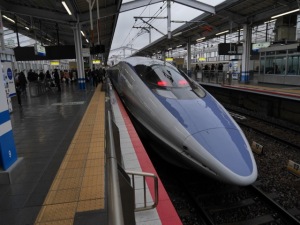
P1080051

The above photograph shows the incredibly sleek Shinkansen at its best and for me at least it has the same impact as the first time the famous black John Player Special Grand Prix car was unveiled to the public many years ago. If a piece of machinery can have sex appeal these two have it in bucketloads!

On arrival at Himeji we opt to take a bus from the station to the castle entrance as we are now in the middle of a torrential downpour. While on the bus I was just about to tell one of my fellow travellers, Lyn, that at least I have not been offered a seat by one of the seated elderly passengers, when, in perfect English a lady says to me ” would you care for a seat? ” As the lady looks  considerably older than I am Lyn, of course, finds the whole affair hilarious. I, naturally decline the kind offer and try to appear as sprightly as possible as I get off the bus.
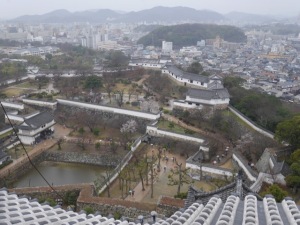
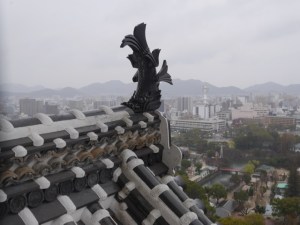
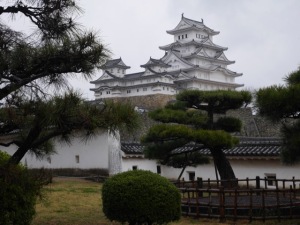
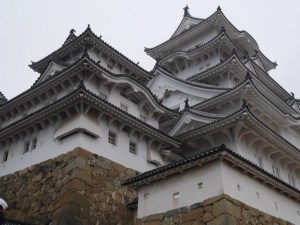
Himeji is widely considered to be Japan’s most beautiful surviving feudal castle and designated both a National Treasure and UNESCO World Heritage site.
As we enter the castle we are required to remove our shoes which we place in plastic bags which we carry around during the whole tour.
The queues to get in are now ridiculously long and the teeming rain only makes matters worse.
The interior of the castle is actually rather underwhelming but one particularly impressive feature is the central wooden pillar from cypress pine which rises vertically through the whole building. I will not forget my ascent to the top of the tower in a hurry as on one of the steep stairs I try to brain myself by bashing my head on a low beam. It’s a whole new experience for me to be taller than much of the local population!

P1080002  P1080007
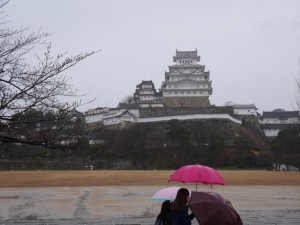
We eventually emerge from the castle to find that the rain is abating somewhat and we, therefore, take a walk up to some of the gardens near the main entrance. From this vantage point we are able to gain a great photo of the castle which is clearly far more impressive from the exterior.

P1080038P1080030P1080016

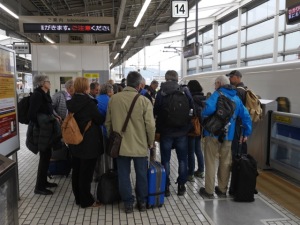
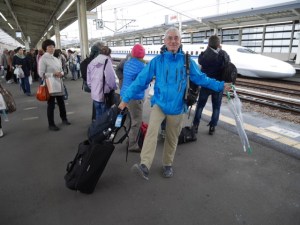
P1070984While waiting on the platform at the railway station for the return trip on the Bullet Train I notice that our motley group is not lining up for the train in the orderly, almost military, precision of the Japanese travellers. I, therefore, point out to them that they are giving Australia a very bad name and soon they have formed a queue which would not look out of place in a Trooping of the Colour Parade in London. Chiaki goes over to an adjoining queue of Japanese who are looking on in wry amusement and explains the reason for this spectacle. Much hilarity which totally debunks the myth of the ‘ inscrutable oriental’.


P1070979  P1080047


On arrival in Okayama we check into our  accommodation for the next 3 nights, Hotel Granvia which maintains the standard to which we have become accustomed.

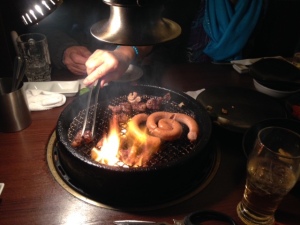
Dinner is at a Japanese restaurant which offers a traditional BBQ. The meat is brought to the table and we cook this on a grid in the centre of said table.
Whilst the ambience of the establishment is great the quality of the food leaves something to be desired and falls short of the very high standard set previously on this tour. To make matters worse the group at our table ( there are two groups) tries to set fire to the restaurant until a waiter comes to our rescue and dowses the worryingly high flames!

IMG_1365
It’s always good to end the day in a blaze of glory!

Off to Hiroshima tomorrow.

Cheers

The Obese Ferret.

Read Full Post »

Japan – Sagano

Day 4 – 30th March 2017

Sagano Arashimaya

An ideal day with the temperature expected to rise to 18 degrees so we head off by train to the beautiful Sagano Arashimaya district due west from Kyoto.
After a short walk we arrive at the Arashimaya Bamboo Park which initially disappoints but finally meets all our expectations as we get closer to the end and a very impressive, dense bamboo plantation.


We next move on to Tenryu-Ji Rinzai Zen Buddhist Temple, established in 1339 by the shogun AshikagaTakauji. In the centuries since its foundingTenryu-Ji has been ravaged by fire a total of 8 times, most recently in 1864. Most of the present buildings thus date only to the Meiji period (1868-1912.
However, the superb Sogenchi Garden behind the Main Hall was the first Special Historic Scenic Area named by the Japanese government and in 1994 it became a World Cultural Heritage site.
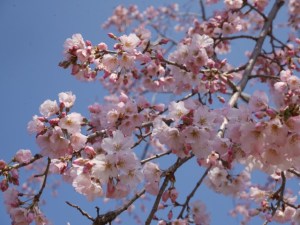
Once again the guide books remind us that during the spring the cherry-blossom make for a memorable stroll through the gardens around the lake. Maybe if we read this often enough our tour will live up to its name but at the moment the blossom is simply not cooperating, at least not to the degree anticipated for the end of March.

P1070803  P1070798


P1070783  P1070787
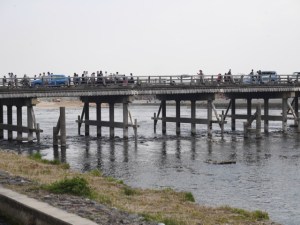
We are now in need of a caffeine fix and Chiaki has suggested that we go to the Arabica coffee shop overlooking the Katsura River not far from the railway station. We find ourselves thwarted in our quest by a long queue and instead backtrack to Tully’s coffee shop at the station, but not before we check out the famous Tugetsu-kyo wooden bridge over the river.

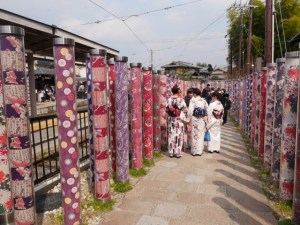
Not in any way daunted by the reluctant cherry blossom the local authorities have erected a superb display of spring decorations along the platforms at the railway station. Hopefully their optimism will be rewarded over the coming days.

P1070815

P1070822

Spring decorations at Sagano railway station

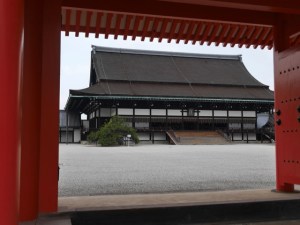
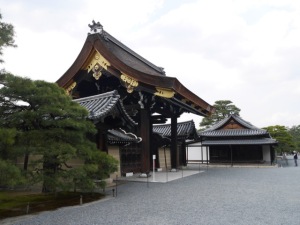
We arrive back at our hotel in Kyoto with time to spare to first take a look at some very rare pink blossom in a nearby street and then it’s off to the Kyoto Imperial Palace. It is no longer the official residence of the Japanese Emperor but it is nevertheless an impressive building. The original imperial palace was built in 794 but was later replaced on a number of occasions after destruction by fire.


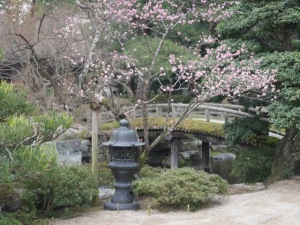
The Imperial Palace Park which surrounds the palace itself is apparently planted with a huge array of flowering trees and is most beautiful in late February and late March with the so far totally non-existent plum and cherry blossom!

P1070856  P1070847

P1070874

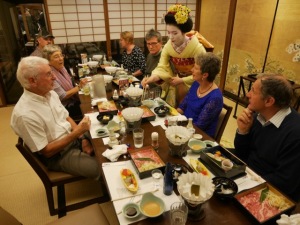
Eight of the group have chosen to go on an optional tour which offers a tradional Japanese dinner with a Geisha performing a couple of traditional dances.
The dinner is held in a restaurant with a private room reserved for our party only.
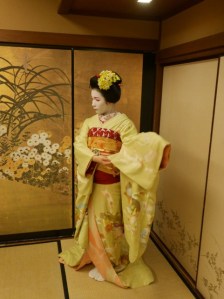
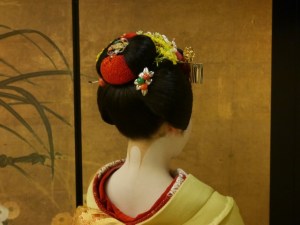
Chiaki gives us a briefing on the strict protocol that applies for such a geisha show and what follows is a very professional and authentic performance. By way of explanation ‘geisha’ is not the term used in Kyoto, recognised as the geisha capital, but instead they are referred as ‘maiko’ for girls 15- 20 years who are still in training and ‘geiko’ if fully-fledged.

P1070947  P1070948

P1070914P1070916

The girl that arrives to entertain us is a delightful young girl of 17 who first performs her dances in what can best be described as a ‘trance-like’ state but who then becomes much more natural as she serves us our drinks and assists us with the use of the chopsticks and the procedure for the meal.

Perhaps the most enlightening part of the evening is when she does a question and answer session with us ( using Chiaki as interpreter ) and in doing so gives us a real insight into the world of the maiko or geiko.
I suspect that some of our group would have felt a degree of sadness that a young girl would devote herself to this type of life but she had clearly not taken this step without going through a lot of soul-searching.
I for one had feared that this evening would be similar to a ‘faux’ performance such we had seen among the Masai tribesmen in Africa but nothing could have been further from the truth with the young maiko putting on a very impressive show.
Gail and Chiaki do provide us with a moment of humour when Gail points to a piece of food in front of her and asks “what is this?’ hoping for some local knowledge. Chiaki merely replies ‘where did you get it from?’ She was actually meaning ” from which plate?”but the  hilarity came more  from Chiaki’s incredulous look and her special way of expressing herself than  her actual words and we were all left wondering what the real source of the food was.
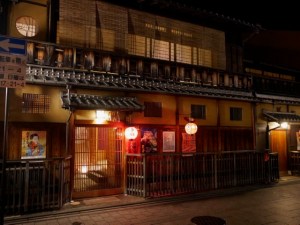
We rounded off a truly memorable evening with Chiaki taking us on a walking tour through the Gion district which is the centre of the Geiko world in Kyoto. We return to the hotel somewhat enlightened but also with many questions about the mystical world of the Geiko/Geisha still left unanswered,

P1070977


Tomorrow it’s off to the famous Himeji Castle and maybe some long-awaited spring blossoms!
Cheers

The Obese Ferret

Read Full Post »

Japan – Kyoto

Day 3 – 29th March 2017
Kyoto
Another clear day with an expected top temperature of 18 degrees and at our usual starting time of 9.00 am we are off on the train to the Shinto Shrine of Fushimi-Inari -Taisha south-east of Kyoto. This vast shrine complex is famous for its thousands of vermilion torii ( gates ) which are spread across the wooded mountain-side. Fushimi-Inari was dedicated to the gods of rice and sake by the Hata family in the 8th century and remains one of the most impressive and visited sites in Kyoto. One unusual feature of the shrine is the hundreds of stone foxes. The fox is considered the messenger of Inari, the god of cereals, and the stone foxes are often called Inari.
In common with other shrines and temples in Japan we are certainly not ‘ Far from the madding crowd’ but I finally manage to put the Go-Pro and extension stick to good use over the top of the hordes.


After returning to the city centre by train we head off on foot to the Nishiki Market to see the huge array of foods that go into Kyoto cuisine. Chiaki is on hand to give us some guidance as we try to select some dishes to keep the pangs of hunger at bay. We end up with something which we find out later is octopus. Definitely an acquired taste!


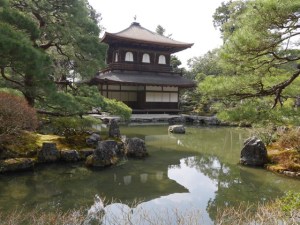
The group now breaks up and Gail and I are joined by Keith from Sydney as we head north-east out of the centre by taxi to visit the Ginkaku-ji Buddhist temple which started its life in 1482 as a retirement villa for shogun Ashikaga Yoshimasa but after his death the villa was converted into a temple. ‘Ginkaku-ji’ literally means’ Silver Pavilion but the shogun failed in his ambition to cover the building with silver.

P1070688


Ginkaku-Ji also marks the start of the very pleasant Path of Philosophy walk which follows a canal lined with cherry trees which usually come into spectacular bloom in late March/ early April. However, Murphy’s Law rears its ugly head again and the blossom is steadfastly refusing to appear so far this year.


We will no doubt be reminding Chiaki that our tour is called ‘Japan Cherry Blossom Dreams 2017’ over the coming days!
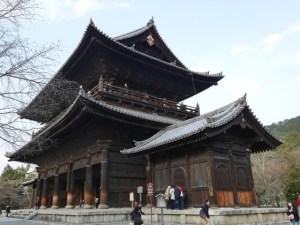
Our walk finishes at the Nansen-Ji Buddhist temple, one of the most impressive in Kyoto with its expansive grounds and the massive Sanmon structure which stands at the entrance.

P1070718
Another taxi ride back to the hotel and it’s time for a short period of relaxation before we meet up with Chiaki and Keith in the hotel lobby.
Chiaki had previously asked the group whether anyone would be interested in going to a small restaurant offering traditional Japanese family food but there had been no takers. We had decided that we would probably go with Keith to a restaurant near the Daimaru dept store but with the prospect of Chiaki dining alone we agreed to join her at Taroya restaurant that she had already lined up pre the group’s apathy to the idea.
We were rewarded with a delightful evening of great food and good company which included a Japanese business owner at the adjoining table as he celebrated his 67th birthday with family members and an employee! In common with most Japanese restaurants of this type smoking is allowed but the ‘birthday boy’ is real gentleman and politely asks us whether we would mind if he has a cigarette. We haven’t the heart to deprive the ‘old’ guy of  this moment of pleasure on his birthday and he goes out of his way to make sure that what little smoke there is doesn’t head towards our table.
A perfect end to another thoroughly rewarding day.
Cheers

The Obese Ferret

Read Full Post »

Day 2 – 28th March 2017
Kyoto/Nara
Awaken to a bright sunny day with the expected high for the day 15 degrees.
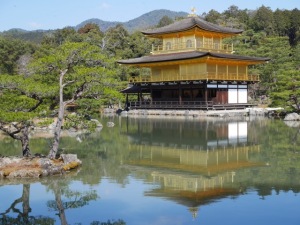
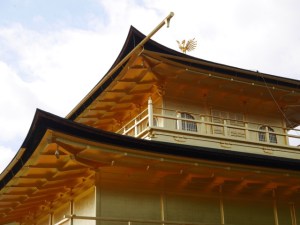
Superb buffet breakfast at the hotel and then it’s off at 9.00am by coach to the Kinkakuji Temple and its most famous feature, the Golden Pavilion. The main hall, covered in magnificent gold leaf and overlooking a very picturesque reflecting pool, is truly spectacular. It is of course a victim of its own appeal and even at this relatively early time of day the hordes are already here. With the impending arrival of the celebrated spring cherry blossom the words ‘peace’ and ‘tranquility’ will cease to be synonymous with this beautiful location.

P1070430  P1070445
For those history buffs out there the original temple was built in 1397 but in 1950 a young monk decided to show his passion for the temple by burning it to the ground. A full reconstruction staying true to the original design was completed in 1955.
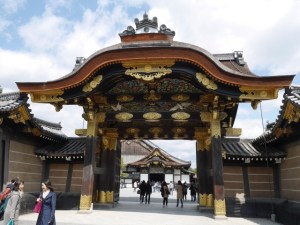
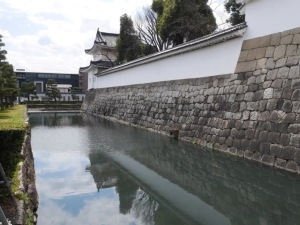
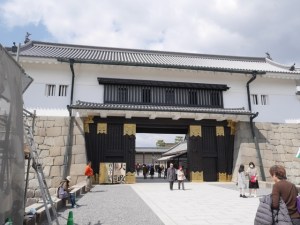
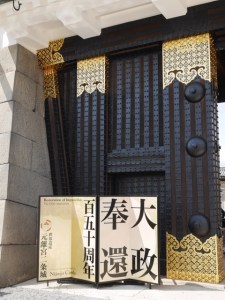
Our next port of call is the Nijo Castle built in 1603 as the official Kyoto residence of the first Tokugawa shogun, Ieyasu. The style of the main palace was clearly designed to demonstrate the prestige and power of the shogun and to underline the demise of the emperor’s power.

P1070484   P1070512

P1070473  P1070476

Over 400 years later visitors are still being put in their subservient place by being obliged to remove their shoes before setting foot within these hallowed walls. One member of our group was apparently forced to borrow a pair of his wife’s socks as his own had a hole in them! ( don’t forget that we had still not received our suitcases from Tokyo and supplies of socks were, therefore, rather limited.)

P1070490P1070485P1070493
Ieyasu was clearly paranoid about the dangers he faced and to safeguard against any treachery he installed in the palace ‘ nightingale floors’ which as the name implies produce the call of a nightingale due to the mixture of wood and metal in their manufacture whenever people tread on them. An ingenious if rudimentary early alarm system!

Before setting off on the drive south to Nara (incidentally the birthplace of our guide Chiaki) we stop at a convenience store to stock up on some lunchtime snacks. The store has a fairly impressive range from which to choose and even the coffee is quite acceptable, notwithstanding the fact that the machine, initially at least, seems in dire need of a good urologist.

We finish off the day with a visit to one of the nation’s most visited sites, the Todaiji temple which houses the Daibutsu ( Great Buddha ), one of the largest bronze figures in the world. Originally cast in 746 and later recast during the Edo period the present statue stands just over 16 metres high and contains 437 tonnes of bronze and 130 kgs of gold.

The sheer immensity of the statue makes for an awe-inspiring sight especially as it is housed in the Daibutsu- den Hall which is one of the largest wooden buildings on earth. It’s perhaps a trifle churlish to mention that the cost of construction of the temple brought the country to the edge of bankruptcy.

With some time to spare before returning to our coach we take a pleasant stroll through the Nara Deer Park although we resist the temptation to spend 150 yen on biscuits to feed to the roaming ,and in some cases ,rather scrawny animals.

Rounding off a very rewarding and enjoyable day most of the group get together for a meal at Donguri , a traditional Japanese restaurant specialising in savoury pancakes. Delicious food at less than $20 a head.

Cheers
The Obese Ferret.

Read Full Post »