Day 4 – 30th March 2017
Sagano Arashimaya
An ideal day with the temperature expected to rise to 18 degrees so we head off by train to the beautiful Sagano Arashimaya district due west from Kyoto.
After a short walk we arrive at the Arashimaya Bamboo Park which initially disappoints but finally meets all our expectations as we get closer to the end and a very impressive, dense bamboo plantation.


We next move on to Tenryu-Ji Rinzai Zen Buddhist Temple, established in 1339 by the shogun AshikagaTakauji. In the centuries since its foundingTenryu-Ji has been ravaged by fire a total of 8 times, most recently in 1864. Most of the present buildings thus date only to the Meiji period (1868-1912.
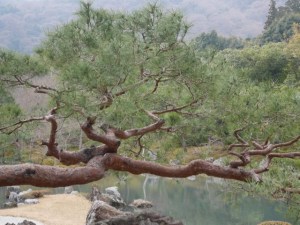
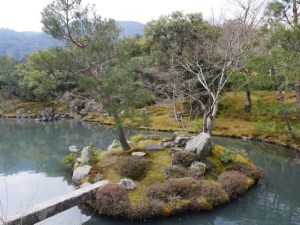
However, the superb Sogenchi Garden behind the Main Hall was the first Special Historic Scenic Area named by the Japanese government and in 1994 it became a World Cultural Heritage site.
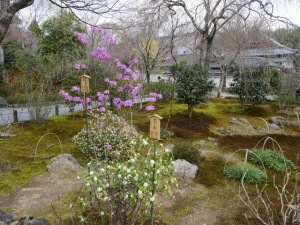
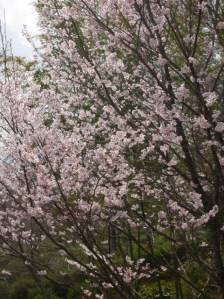
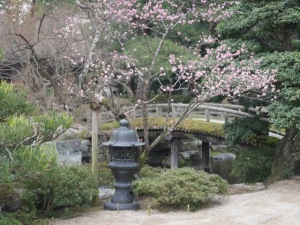
Once again the guide books remind us that during the spring the cherry-blossom make for a memorable stroll through the gardens around the lake. Maybe if we read this often enough our tour will live up to its name but at the moment the blossom is simply not cooperating, at least not to the degree anticipated for the end of March.
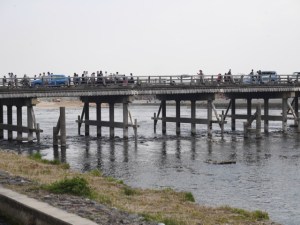
We are now in need of a caffeine fix and Chiaki has suggested that we go to the Arabica coffee shop overlooking the Katsura River not far from the railway station. We find ourselves thwarted in our quest by a long queue and instead backtrack to Tully’s coffee shop at the station, but not before we check out the famous Tugetsu-kyo wooden bridge over the river.
Not in any way daunted by the reluctant cherry blossom the local authorities have erected a superb display of spring decorations along the platforms at the railway station. Hopefully their optimism will be rewarded over the coming days.
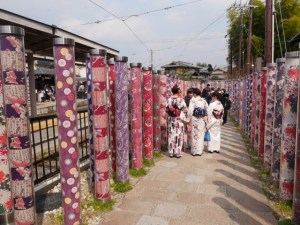
Spring decorations at Sagano railway station
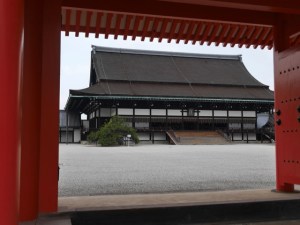
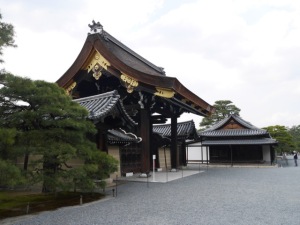
We arrive back at our hotel in Kyoto with time to spare to first take a look at some very rare pink blossom in a nearby street and then it’s off to the Kyoto Imperial Palace. It is no longer the official residence of the Japanese Emperor but it is nevertheless an impressive building. The original imperial palace was built in 794 but was later replaced on a number of occasions after destruction by fire.


The Imperial Palace Park which surrounds the palace itself is apparently planted with a huge array of flowering trees and is most beautiful in late February and late March with the so far totally non-existent plum and cherry blossom!
Eight of the group have chosen to go on an optional tour which offers a tradional Japanese dinner with a Geisha performing a couple of traditional dances.
The dinner is held in a restaurant with a private room reserved for our party only.
Chiaki gives us a briefing on the strict protocol that applies for such a geisha show and what follows is a very professional and authentic performance. By way of explanation ‘geisha’ is not the term used in Kyoto, recognised as the geisha capital, but instead they are referred as ‘maiko’ for girls 15- 20 years who are still in training and ‘geiko’ if fully-fledged.
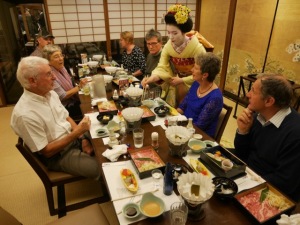
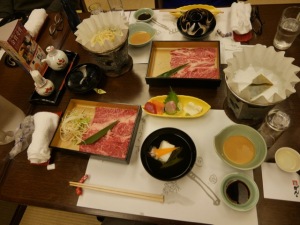
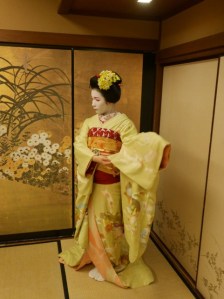
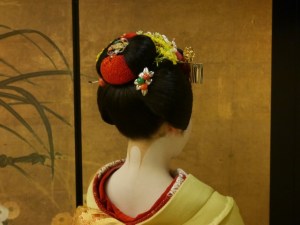
The girl that arrives to entertain us is a delightful young girl of 17 who first performs her dances in what can best be described as a ‘trance-like’ state but who then becomes much more natural as she serves us our drinks and assists us with the use of the chopsticks and the procedure for the meal.
Perhaps the most enlightening part of the evening is when she does a question and answer session with us ( using Chiaki as interpreter ) and in doing so gives us a real insight into the world of the maiko or geiko.
I suspect that some of our group would have felt a degree of sadness that a young girl would devote herself to this type of life but she had clearly not taken this step without going through a lot of soul-searching.
I for one had feared that this evening would be similar to a ‘faux’ performance such we had seen among the Masai tribesmen in Africa but nothing could have been further from the truth with the young maiko putting on a very impressive show.
Gail and Chiaki do provide us with a moment of humour when Gail points to a piece of food in front of her and asks “what is this?’ hoping for some local knowledge. Chiaki merely replies ‘where did you get it from?’ She was actually meaning ” from which plate?”but the hilarity came more from Chiaki’s incredulous look and her special way of expressing herself than her actual words and we were all left wondering what the real source of the food was.
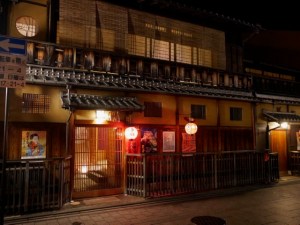
We rounded off a truly memorable evening with Chiaki taking us on a walking tour through the Gion district which is the centre of the Geiko world in Kyoto. We return to the hotel somewhat enlightened but also with many questions about the mystical world of the Geiko/Geisha still left unanswered,


Tomorrow it’s off to the famous Himeji Castle and maybe some long-awaited spring blossoms!
Cheers
The Obese Ferret

 2geonomads
Leave a comment