Day 6 – 1st April 2017
Okayama/ Hiroshima/Miyajima Island
We have been anticipating this day for some time now but given the devastation wrought on Hiroshima on the 8th of August 2017 we expect the visit to this site to be both exciting and very confronting.
We are blessed with some fine weather as we take the short rail journey to Hiroshima and on arrival take a short walk to the ferry terminal from where we will leave to cross to Miyajima Island, famous for Itsukushima Shrine and the floating torii gate. This gate is officially one of Japan’s ” Top 3 Views” and another UNESCO World Heritage Site. The Miyajima Sacred Goddess Floating Shrine is believed to protect the inland sea over which we have come.
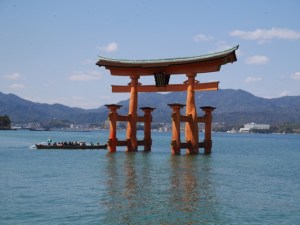


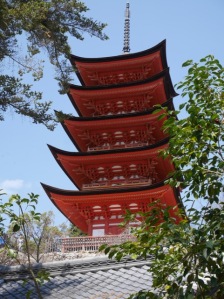
After walking along the waterfront to gain the best photographic vantage points for the floating gate we make a short climb up to a pagoda which is set amongst some beautiful CHERRY BLOSSOMS. Hallelujah!
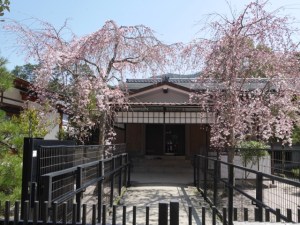
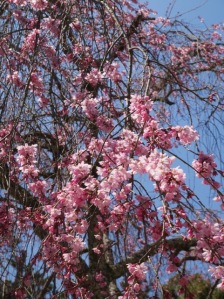
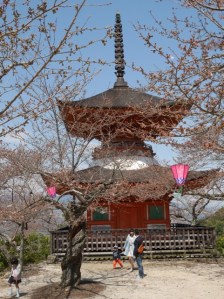
On the start of our walk we had spotted a specialty shop offering waffles and hot chocolate and we returned there to sample their fare.
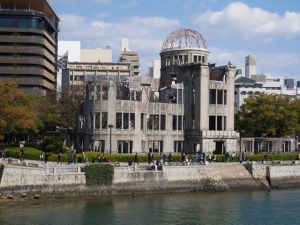
On arrival back at the ferry terminal on the mainland we take a tram to A-Bomb Dome, which marks the spot where at 8.15 am on 8th August 1945 the first atomic bomb was detonated approximately 600 metres above the city centre.
The heat rays and blast burned and crushed nearly all buildings within 2 kms of this hypocentre, taking thousands of lives and leaving many more with appalling injuries.
After crossing over the Hiroshima River we stop to take some photos of what remains of the Dome and then proceed into the Peace Memorial Park, stopping along the way to ring the huge Peace Bell and to view the Children’s Peace Monument.
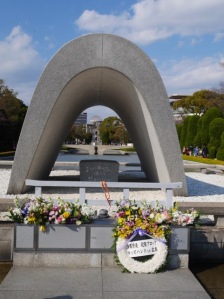
Before entering the Hiroshima Peace Memorial Museum we also stop at the Cenotaph for the A- Bomb Victims. From this location we are able to gain a memorable view through an arch all the way down to the Dome.


It’s now time to conclude our visit to this city with over an hour at the Museum.
Regardless of what we may have read or seen about that fateful August morning in 1945 the images and objects showing very graphically the aftermath of the bombing will no doubt remain with us for long into the future.
Not surprisingly the Museum focuses on the impact of the bombing on Japan and its people with only a brief reference to the Japanese aggression that triggered the war and its repercussions. Notwithstanding the re-writing of history that has taken place the pain and suffering is there for all to see and no person embodies this more than a girl by the name of Sadako Sasaki.
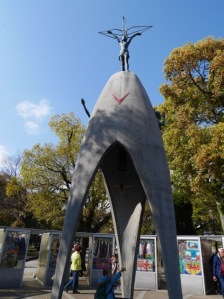
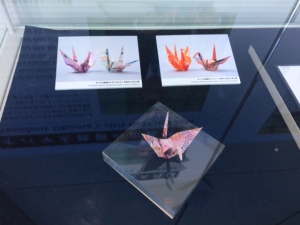
Sadako was exposed to the A-Bomb when she was 2 years old and initially seemed to have emerged unscathed to become a very good young athlete. Sadly after 10 years she started to show signs of leukaemia. However, during her fight against this illness she started doing origami with the aim of folding 1000 paper cranes in the hope of finding a cure. Despite her efforts her life ended after a painful struggle. Sadako’s plight later become known internationally and even today she remains a symbol of hope and determination.
A truly memorable and thought-provoking day ends when we return to the station and the short trip back to Okinawa.
As we don’t have a group dinner organised for the evening we all troop off to a large dept store near to the hotel and eventually we find ourselves, together with Keith, in the ‘fast food’ department on the 4th floor. Never has an area been more inappropriately named as it takes 40 minutes for two very basic pasta-type dishes to arrive. To be fair the food is very good but I was by now too weakened by the lack of sustenance to appreciate the these culinary gems!
Cheers
The Obese Ferret.

 2geonomads
If I recall correctly, Hiroshima was populated entirely by school girls at the time of the bombing. The Second General Army presumably being out on a picnic.